Bare Breasts. Dictators. War.
That is Africa according any media company owned by Rupert Murdoch. However, this is not what I expected to encounter when I went to check out my first real performance art exhibition on Wednesday 15 June 2011.
There was a small storm brewing - bits of lighting happening in the distance and a cold breeze blowing through the trees (we were in Observatory so forgive me for observing-the-trees). An obscure, empty double-storey building in Barrington Street, was the venue and it only added to the uneasy feeling I had inside.
As I got out my car, I bumped into a couple of familiar faces and we proceeded to get into the usual chit-chat. I calmed down. Nothing to worry about. After about 15 minutes of jealously watching them smoking cigarettes (I used to love smoking in cold weather), I got fed up and bored of the banter so I walked away from the crowd to make my entrance into...well, I didn't know what I was making my way into.
Through the hallway and straight into the first room.
My jaw dropped and I think I twitched slightly. It was the kind of shock that a little boy experiences mistakenly walking into the girl's bathroom. I shuffled awkwardly out the room without taking note of anything other than the variety of nipples on display.
Breathe.
There was only one thing to do at this point: down my first glass of wine and take the second glass with me. I peered back at the door of the room and saw a few people exiting with similar half-smiles on their faces.
"Okay," I told myself, "don't go straight back into the room, you'll look like a pervert." So I asked one of the full-clothed hostesses if there was anything else to see. She pointed me towards the second room at the back of the bottom floor.
This was much easier to digest, more like what I'm used to in the world of so-called'art'.
There was a projection of documentary footage on war in Africa, amongst other things onto a jarred backdrop of African fabrics. This was safer, but my mind was working over-time trying to digest the previous scene. And that first glass of wine wasn't really helping slow the thoughts, so down with the second...
"Where to next?" I asked. "Upstairs," she said, almost daring me.
Here I found the House Nigger serving shots, shots of milk. I couldn't decide whether the prospect of rediscovering my love for breast milk was strong enough so I declined and continued sipping my third glass of wine. I nodded respectfully as I walked up past the coon, looking back as I walked up.
Coming up the stairs, I could vaguely hear war-like sounds approaching - army general-like speeches and exploding paraphernalia. But I was so thoroughly mixed up in my thoughts that I just kept going as if nothing was happening.
As I approached the next room, what the cape coloureds call a klappetjie went off...okay...walk slower...gulp...
There was the Dictator sitting taking notes, devising her plans whilst a speech about freedom that I vaguely remember hearing somewhere was blaring in the background. She kept throwing klappetjies against the wall, adding to the unapproachable atmosphere of the entire installation. Above all of this commotion was the violent humming of the breast milk pump...
I couldn't figure out if this made me want to go back and take those shots of milk or not. I lost my composure and slipped into the next room like a scared little rabbit when gets out its hole not knowing where it popped out.
Escape. Next room. Be calm. BE A MAN!
Fresh, bleeding hearts with the flags of African states pierced into them.
Shit! What the fuck?!
I went downstairs to join the crowd outside. A place of safety. More hipster chit-chat. I made irreverent jokes about breasts - I don't like to project myself as an art aficionado.
But the truth is: I was moved.
Art is meant to move something inside you, if it doesn't then it has failed. And art is really art when you're left feeling unsure what inside you has changed. But who am I to say what is and isn't art?
I hung around for two more hours and finally managed to work off my immaturity and took the time to notice the nuances. The writing on the wall surrounding the breasts. The milk being collected beneath each of them. The photographs and scraps of paper around the Dictator.
But I am not go an artistic interpretation of the meaning behind all of this because a) I do not like to present myself as an art critic because I am not one; and b) I do not yet have the right words to describe my interpretations.
I went to dinner with some people straight after this and the one girl who is definitely an artist herself said: "Never show the nipples, they're too powerful, no-one will take anything out of the performance."
I must admit, this is somewhat true, the breasts were pretty dominating. But I find this interesting. I had no idea that nudity could have such a profound impact on my ability to digest information. But I do believe that this was part of the message. The breasts were not randomly placed in the middle of nowhere - they were the message.
The power of the female form and the centrality of breasts to human life was demonstrated brutally. Breasts are the source of our first comfort and sustenance in this world. Aren't breasts the real reason why we love our mothers so much?
But in later life, men find all sorts of new ways to feed this hunger and to seek comfort from this world - one of which is the lust for power, much like my seemingly uncontrollable lust for breasts...and one of the most ghastly aspects of war for me is not the killing but the raping that goes mostly unspoken. Why are men such beasts?
Am I a beast?
I salute the creators of this brave piece of art. You have shown me just how raw human nature really is and how much I still need to learn about myself in order to be able to digest the reality of the issues facing myself and our continent.
The poster said "get the taste out your mouth" and I haven't quite yet managed to.
Photography courtesy of Adam Kent Wiest
Showing posts with label south africa. Show all posts
Wednesday, July 6, 2011
Tuesday, June 14, 2011
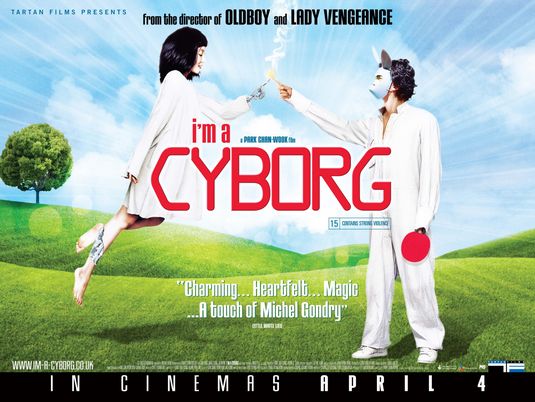
Film Review: I'm A Cyborg But That's OK
A friend of mine recently nagged me into watching this movie. I was hesitant because I'm wary of subtitles, I'm not sure why. I think I assume I'm lazy. But I usually love movies with subtitles, once I watch them. This is one of them.
When I was in India in 2007/8, I met a guy with the most awesome taste in world film. He told me back then that Korea was producing the most conceptually advanced film in the world. This movie is, shamefully, my first real taste of this.
The title of the film is: I'm A Cyborg But That's OK. The plot centres around a girl, Young-goon, who is admitted to an insane asylum because she believes that she is a cyborg.
The opening scenes are masterfully crafted and the line between reality and insanity is never clear; for the whole film you're left guessing. I was left enthralled from the beginning to the end.
It is so interesting to view life and the world through a totally different cultural, historical and philosophical lens. It's something only creativity can do: give you a glimpse into the soul of a mind you will never know.
Anyway, there are many other characters but the other main character is Il-Sun — played by the Korean pop-heartthrob Rain.
He plays the role of the antagonist. He is a thief, and he steals the thing that is most dear to you. But he is also The Saviour, the character who brings relief to the storyline, but I won't give away what he does.
I am purposefully not going to speak about the storyline. I may have my own interpretation that is skewed and I think it would be boring to hear my rendition of it. However, let me briefly explain what intrigued me about some of the messages in the film.
The first is that a cyborg was used to explore human emotion and existentialism. There is a beautiful scene where Young-goon is meditating via her radio and speaks to the Machine God or whatever it is. She says that all machines are created with their unique purpose of existence, and she wishes she knew hers.
The film is largely about this seeking but without being directly about it. It's not an entirely philosophical movie, it's also fantastical, odd and funny.
The second is the key to her finding her purpose, the rule-book, the formula. It's the seven deadly sins for cyborgs.
The 7 Deadly Sins are:
1. Sympathy
2. Being Sad
3. Restlessness
4. Hesitating about anything
5. Useless Daydreaming
6. Feeling Guilty
7. Thankfulness (shown in the picture above)
I can agree with most of these, when it comes to creativity, except for thankfulness and sympathy. But that could be my euro-centric socialization at play, perhaps there is great wisdom behind this, I don't know. In any case, I liked having my moral assumptions tested. But the result of her finally losing her sympathy kind of makes me feel sure that I'd like to keep mine. I won't give away what happens but it's pretty crazy.
Lastly, the film also addressed the idea of energy. Machines use electricity as energy, but it doesn't work for humans. So a large part of the film is about trying to get Young-goon to eat - food, instead of licking batteries...I think this applies to a larger theme of where we draw energy and inspiration from and the need to remain cognizant of whether our energy source is in fact giving you energy or if it's all in your head...That aside, I find it cute the way her toes light up when she gets energy.
Conclusion
Artistically, this is a beautifully crafted film. Philosophically, it's very interesting and mind-opening. It's not for everyone's taste and people with a better knowledge of Asian films might know better films. However, as an introduction to the breadth to which film can take us, this was a fresh experience for me.
Philosophically, I found one thing stuck in my mind. It's very Foucaultian but reality is such a fluid thing. The line between sanity and insanity is subjective and relative.
What you believe to be true is equally as important to what is actually true. Belief creates reality, or at least the two an inextricably linked. This begs the question of the meaning of truth: is it what we believe to be true or what is truly true and how can we ever know other than what we believe? But that is a whole other debate for another day, or perhaps another lifetime, if you believe in shit like that.
Here's an interesting music video/trailer that gives you a good idea of the artistic feel of the film, but none of the content, you have to watch it for that:
Finally, I actually have a point.
In South Africa, we're suffocated by American pop film and music because of the massive power of the American entertainment corporations, the four major distribution labels.
But this shouldn't kill our creativity. What is up with us?
Nigeria has a hustling, bustling film industry. What about us?
Okay, we have Tsotsi and District 9 and White Wedding, but can we claim that these have a uniquely South African film aesthetic? Or are they just South African stories done according to some international (American) standard? Or am I just ignorant to volumes of monumental South African films lying in the dusty corners of the SABC?
When you see a Nollywood movie, you know it. When you see a Bollywood movie, you know it. When you see a South African movie, you see...Hollywood?
I believe there is space and a need for a uniquely South African narrative style, philosophical lens, political message and aesthetic approach.
Other than Leon Schuster.
When I was in India in 2007/8, I met a guy with the most awesome taste in world film. He told me back then that Korea was producing the most conceptually advanced film in the world. This movie is, shamefully, my first real taste of this.
The title of the film is: I'm A Cyborg But That's OK. The plot centres around a girl, Young-goon, who is admitted to an insane asylum because she believes that she is a cyborg.
The opening scenes are masterfully crafted and the line between reality and insanity is never clear; for the whole film you're left guessing. I was left enthralled from the beginning to the end.
It is so interesting to view life and the world through a totally different cultural, historical and philosophical lens. It's something only creativity can do: give you a glimpse into the soul of a mind you will never know.
Anyway, there are many other characters but the other main character is Il-Sun — played by the Korean pop-heartthrob Rain.
He plays the role of the antagonist. He is a thief, and he steals the thing that is most dear to you. But he is also The Saviour, the character who brings relief to the storyline, but I won't give away what he does.
I am purposefully not going to speak about the storyline. I may have my own interpretation that is skewed and I think it would be boring to hear my rendition of it. However, let me briefly explain what intrigued me about some of the messages in the film.
The first is that a cyborg was used to explore human emotion and existentialism. There is a beautiful scene where Young-goon is meditating via her radio and speaks to the Machine God or whatever it is. She says that all machines are created with their unique purpose of existence, and she wishes she knew hers.
The film is largely about this seeking but without being directly about it. It's not an entirely philosophical movie, it's also fantastical, odd and funny.
The second is the key to her finding her purpose, the rule-book, the formula. It's the seven deadly sins for cyborgs.
The 7 Deadly Sins are:
1. Sympathy
2. Being Sad
3. Restlessness
4. Hesitating about anything
5. Useless Daydreaming
6. Feeling Guilty
7. Thankfulness (shown in the picture above)
I can agree with most of these, when it comes to creativity, except for thankfulness and sympathy. But that could be my euro-centric socialization at play, perhaps there is great wisdom behind this, I don't know. In any case, I liked having my moral assumptions tested. But the result of her finally losing her sympathy kind of makes me feel sure that I'd like to keep mine. I won't give away what happens but it's pretty crazy.
Lastly, the film also addressed the idea of energy. Machines use electricity as energy, but it doesn't work for humans. So a large part of the film is about trying to get Young-goon to eat - food, instead of licking batteries...I think this applies to a larger theme of where we draw energy and inspiration from and the need to remain cognizant of whether our energy source is in fact giving you energy or if it's all in your head...That aside, I find it cute the way her toes light up when she gets energy.
Conclusion
Artistically, this is a beautifully crafted film. Philosophically, it's very interesting and mind-opening. It's not for everyone's taste and people with a better knowledge of Asian films might know better films. However, as an introduction to the breadth to which film can take us, this was a fresh experience for me.
Philosophically, I found one thing stuck in my mind. It's very Foucaultian but reality is such a fluid thing. The line between sanity and insanity is subjective and relative.
What you believe to be true is equally as important to what is actually true. Belief creates reality, or at least the two an inextricably linked. This begs the question of the meaning of truth: is it what we believe to be true or what is truly true and how can we ever know other than what we believe? But that is a whole other debate for another day, or perhaps another lifetime, if you believe in shit like that.
Here's an interesting music video/trailer that gives you a good idea of the artistic feel of the film, but none of the content, you have to watch it for that:
Finally, I actually have a point.
In South Africa, we're suffocated by American pop film and music because of the massive power of the American entertainment corporations, the four major distribution labels.
But this shouldn't kill our creativity. What is up with us?
Nigeria has a hustling, bustling film industry. What about us?
Okay, we have Tsotsi and District 9 and White Wedding, but can we claim that these have a uniquely South African film aesthetic? Or are they just South African stories done according to some international (American) standard? Or am I just ignorant to volumes of monumental South African films lying in the dusty corners of the SABC?
When you see a Nollywood movie, you know it. When you see a Bollywood movie, you know it. When you see a South African movie, you see...Hollywood?
I believe there is space and a need for a uniquely South African narrative style, philosophical lens, political message and aesthetic approach.
Other than Leon Schuster.
Monday, April 4, 2011
YOU ARE THESIS.
We all have individual and collective identities that battle, fuse & combine to make up our social reality.
I've been thinking for a while about whether the alter-ego theory can be applied to groups. I've always felt that it can but haven't been able to express it.
Then I came into contact with Thesis.
Thesis a fashion/lifestyle brand that has it's base in Mofolo, Soweto, Johazardousburg, South Africa.
It's run by five Sowetan youth who've been building the movement since 16 June 2007. But let me not say too much myself: here's an amateur video I put together from my various visits to Thesis over the past 6 months:
Thesis stands out to me because of the rich concept behind; its social dimensions and the way that it is aimed at changing people's approach to life.
Thesis pays homage to the slain youth of 1976, through it's opening date.
This conceptual link interests me. It shows the passage of time and the connectedness of history to the present. The youth of 1976 were fighting against being taught in Afrikaans - a language that clashed with their sense of identity.
In many ways language is a cornerstone of cultural identity because it determines your mode of thinking. I've heard that Native Americans couldn't grasp the concept of a wave crashing; they saw the wave continuing into the land, all because their language had no punctuation. There is no full stop.
In this way, if you are forced to speak a language, you are forced into a cultural mold & ultimately you will change.
The youth of 1976 wouldn't accept this imposition - they fought and died for their right to oppose Afrikaans cultural imperialism. It was a symbolic fight; one that said: we will not allow you to define our identity.
Identity is one of the great youth conundrums. Trying to figure out where you fit, what you want to become, who you want to be.
The old and wise advise: just be yourself.
The Thesis slogan speaks to this wisdom: "wear your own identity, culture, style and experience.”
Essentially, the concept of Thesis challenges South African youth, especially in the townships, to define/redefine themselves according to their own terms & then use this as a springboard to nurture a creative culture.
The youth create the future & by addressing our identity head-on, we create ourselves.
Thesis is an alter-ego for a collective, providing a portal to escape the boxes of what we think is impossible.
You are Thesis. I am Thesis. We are Thesis.
Check out my full profile on the Thesis Social Jam Sessions in the latest issue of one small seed
I've been thinking for a while about whether the alter-ego theory can be applied to groups. I've always felt that it can but haven't been able to express it.
Then I came into contact with Thesis.
Thesis a fashion/lifestyle brand that has it's base in Mofolo, Soweto, Johazardousburg, South Africa.
Thesis stands out to me because of the rich concept behind; its social dimensions and the way that it is aimed at changing people's approach to life.
Thesis pays homage to the slain youth of 1976, through it's opening date.
This conceptual link interests me. It shows the passage of time and the connectedness of history to the present. The youth of 1976 were fighting against being taught in Afrikaans - a language that clashed with their sense of identity. In many ways language is a cornerstone of cultural identity because it determines your mode of thinking. I've heard that Native Americans couldn't grasp the concept of a wave crashing; they saw the wave continuing into the land, all because their language had no punctuation. There is no full stop.
In this way, if you are forced to speak a language, you are forced into a cultural mold & ultimately you will change.
The youth of 1976 wouldn't accept this imposition - they fought and died for their right to oppose Afrikaans cultural imperialism. It was a symbolic fight; one that said: we will not allow you to define our identity.
Identity is one of the great youth conundrums. Trying to figure out where you fit, what you want to become, who you want to be. The old and wise advise: just be yourself.
The Thesis slogan speaks to this wisdom: "wear your own identity, culture, style and experience.”
Essentially, the concept of Thesis challenges South African youth, especially in the townships, to define/redefine themselves according to their own terms & then use this as a springboard to nurture a creative culture.
The youth create the future & by addressing our identity head-on, we create ourselves.
Thesis is an alter-ego for a collective, providing a portal to escape the boxes of what we think is impossible.
You are Thesis. I am Thesis. We are Thesis.
Check out my full profile on the Thesis Social Jam Sessions in the latest issue of one small seed
Subscribe to:
Posts (Atom)